Digital Audio Watermarking with DSSS
This course project implements a Direct-Sequence Spread Spectrum audio watermarking system for embedding a binary image watermark into music and speech. The goal is to balance imperceptibility and robustness: the watermark should stay below the audible influence of the host signal, but still be recoverable after noise, filtering, resampling, echo, and requantization.
Background
Audio watermarking hides copyright or identification data inside a host signal without obvious perceptual artifacts. The project uses auditory masking as the design intuition: when the host audio is strong enough, a carefully shaped watermark can be embedded at a low relative level and remain difficult to hear.
DSSS Watermarking
Each watermark bit is spread with a pseudorandom chip sequence, modulated into an audio-frequency band, and mixed into the host. At the receiver, the same spreading sequence acts like a key: correlation with the received signal recovers the hidden bit stream, even when part of the spectrum has been disturbed.
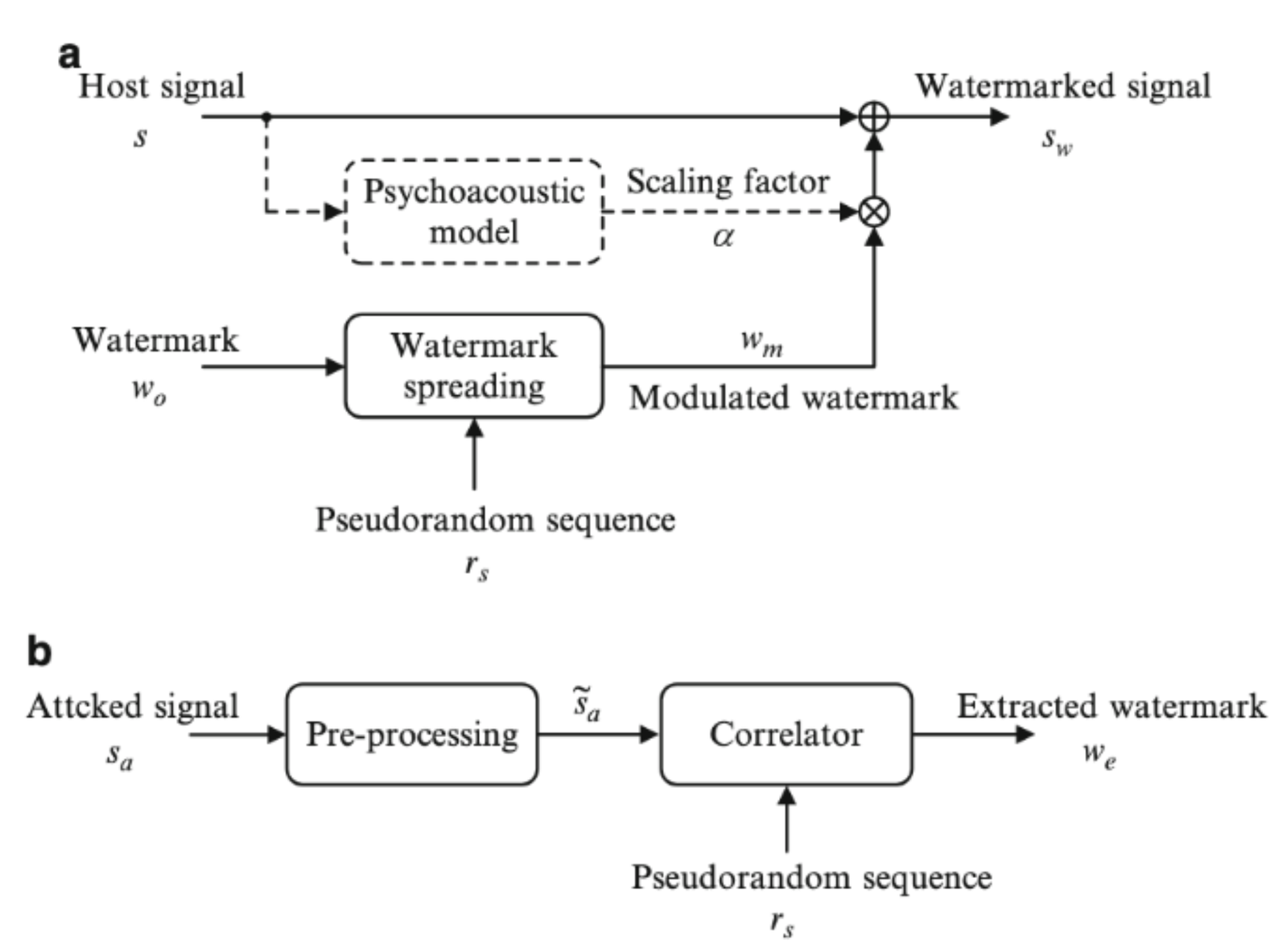
The system has two matching halves. In the embedding path, the host signal controls the allowed watermark strength through a psychoacoustic scaling factor, while the watermark payload is spread into a noise-like signal. In the extraction path, preprocessing isolates the received watermark band, and correlation with the original pseudorandom sequence reconstructs the embedded image.
Global Spread Spectrum
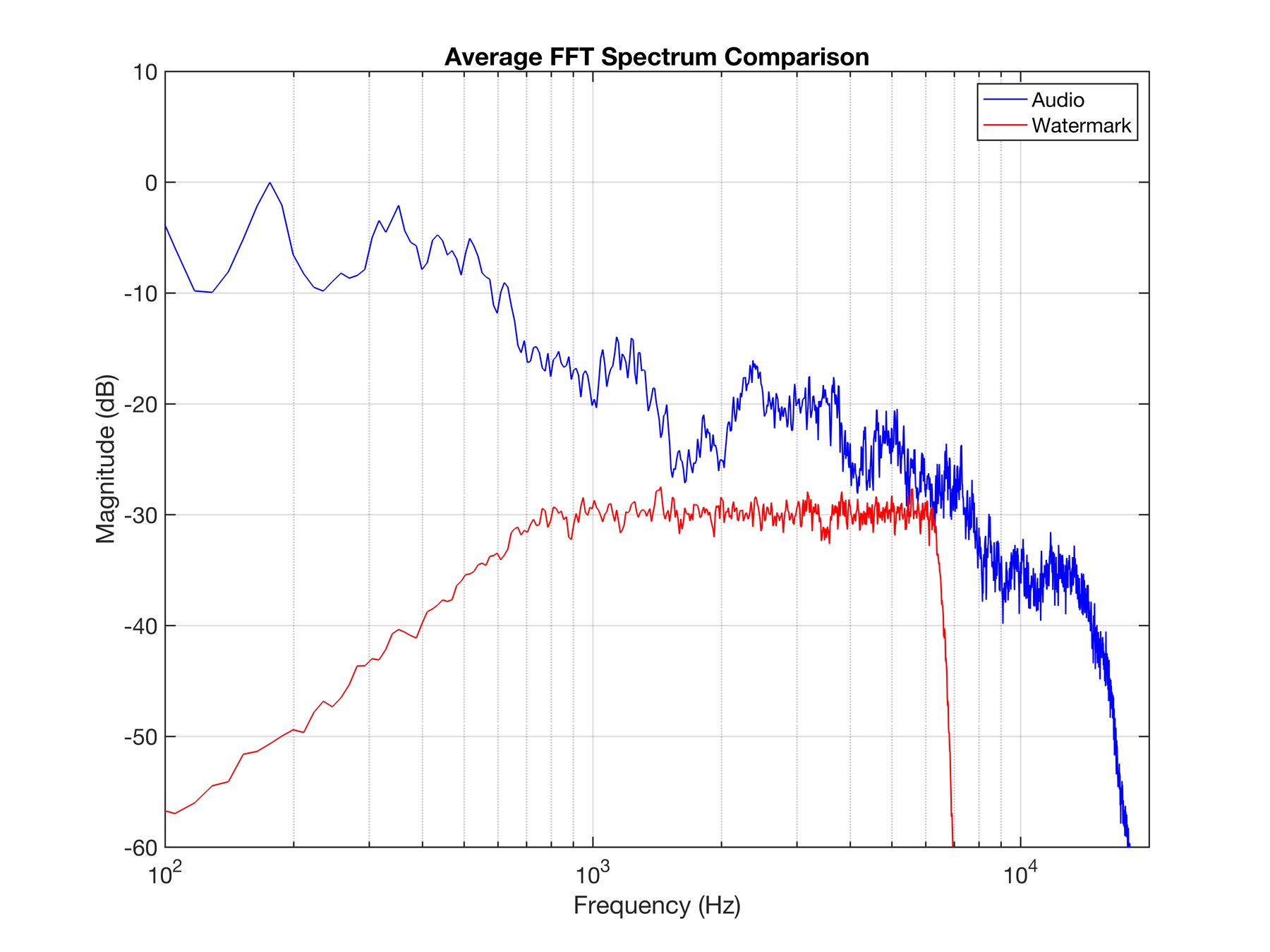
This comparison became a key design decision. Symbol-wise spreading repeatedly reuses short sequences, which can create structured spectral lines and audible clicking artifacts. Global spreading uses one long pseudorandom sequence across the full payload, making the watermark behave more like continuous band-limited noise and reducing perceptual artifacts at the same watermark energy.
Adaptive Embedding
The final embedding stage uses a time-varying gain based on the host signal envelope. Louder passages can tolerate stronger watermark energy, while quiet passages are protected with lower gain. This keeps the watermark less noticeable while preserving enough energy for extraction.
Extraction Robustness
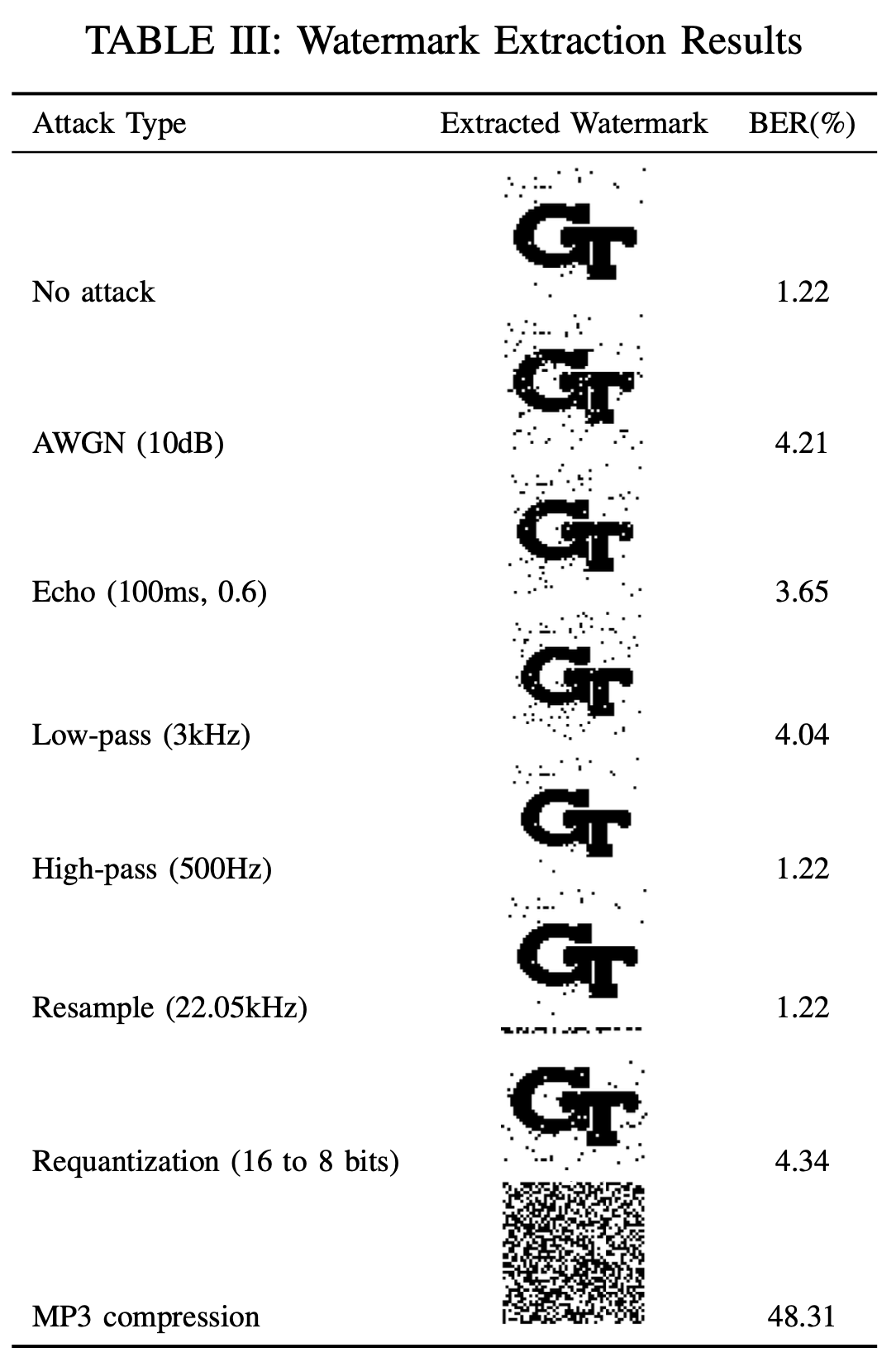
The extraction results show the main tradeoff. The DSSS watermark is robust to many conventional distortions because the hidden information is distributed over a wide frequency band. However, perceptual lossy compression removes subtle spectral components, so MP3 severely damages the embedded image. Future improvements would likely need error-correction coding and a more detailed psychoacoustic embedding model.