Headphone Characterization with nLMS Adaptive Filter
Headphone frequency response is traditionally measured using logarithmic sine sweeps and deconvolution techniques. In this project, an adaptive filtering approach is used to identify the headphone's linear transfer function directly from broadband excitation signals. As a result, the system can estimate the headphone response as a set of FIR filter coefficients using arbitrary broadband content (such as music) rather than dedicated test signals. The identified FIR model can then be used to simulate the headphone's response to different program materials or to separate the linear component from the measured output, enabling further analysis of nonlinear processing blocks or distortion in the system.
Pink Noise Stimulus
In this experiment, I used recordings of pink noise (30 seconds long) to determine the frequency response of the headphone. Recordings are made with miniDSP UMIK-1 microphone on a 3D-printed test fixture of my own design.
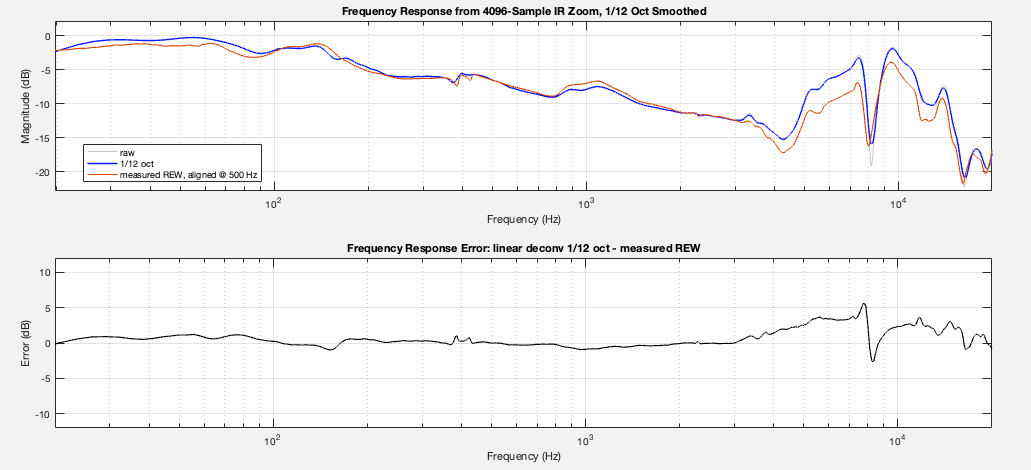
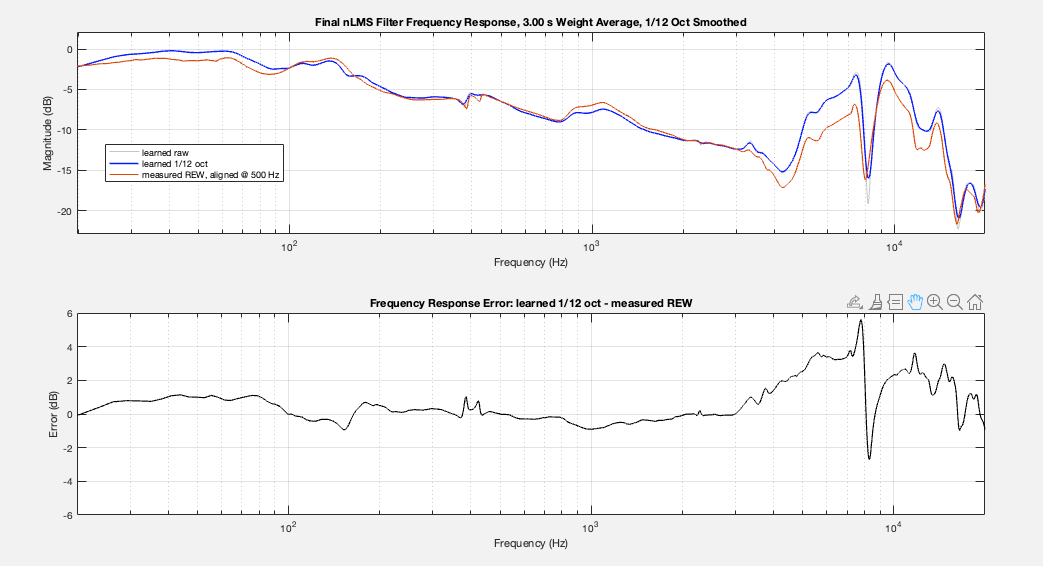
With this broad-band, stationary signal, both methods perform very well. The difference between log-sweep measurement and the two methods under test in high frequencies are from different headphone positioning on the test fixture between the log-sweep measurement and audio recording.
Music Stimulus
In this experiment, I used recordings of music playback (Billie Jean by Michael Jackson, 30 seconds long) to determine the frequency response of the headphone.
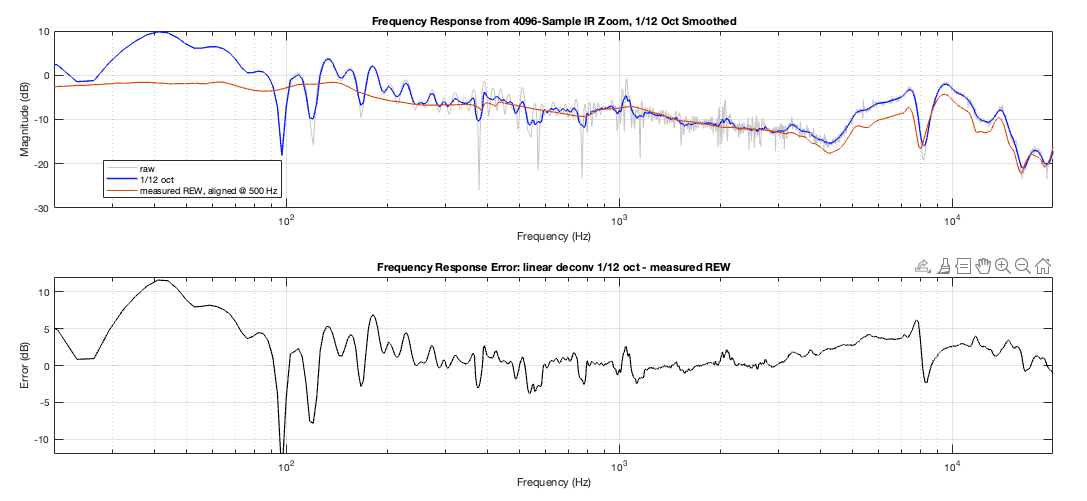
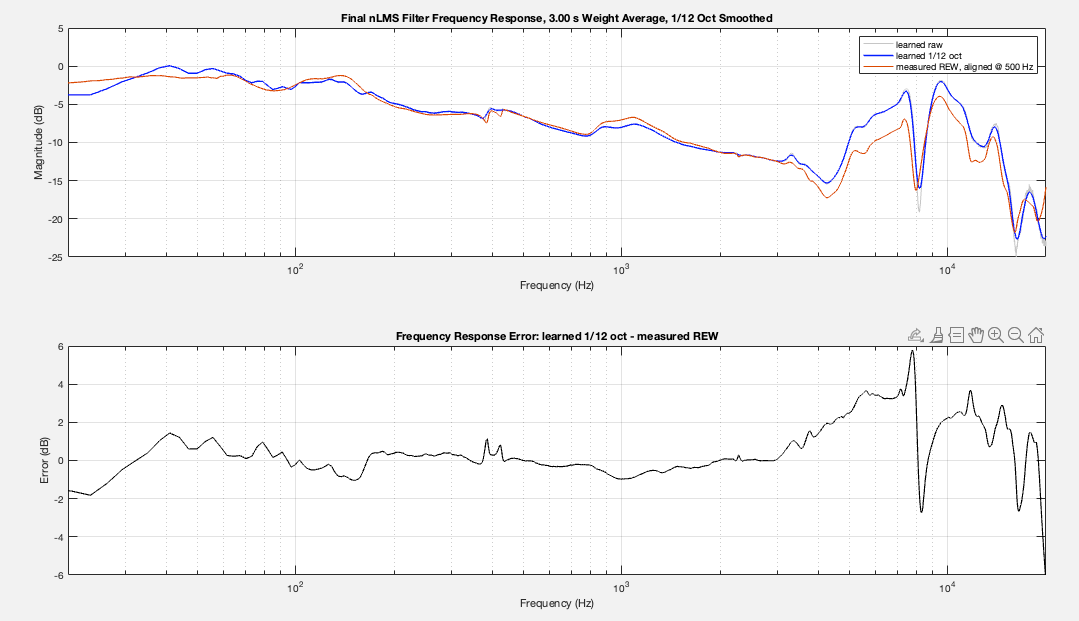
The adaptive filter still performs well, with minimal deviation from the pink noise stimulus result. Only very low frequency (20Hz-40Hz) is affected due to the lack of music energy in that region. Overall, the adaptive filter method is reliable and robust enough to learn the linear response of a headphone. This will come in handy if we want to test the product with real music signals instead of sweeps. In addition, this can be used to derive a 'average' frequency response on modern audio products with time-variant and non-linear processing blocks like dynamic range compression and volume dependent processing. This method can be reasonably expanded to loudspeaker testing with the right recording techniques.